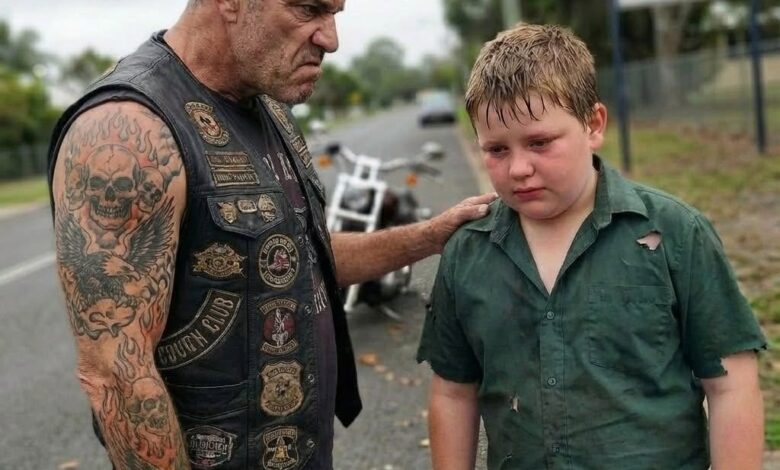
The rural road was desolate, stretching out like a jagged scar through the countryside, when I saw him—a solitary figure trudging along the shoulder, his frame hunched in defeat. His clothes were shredded, his head hung low, and his hands bore the unmistakable, raw markings of a violent struggle he seemed desperate to keep secret. As I slowed my motorcycle, the sight of a child walking four miles alone in such a state triggered an immediate, sinking dread in my gut. What kind of hell had he been forced to endure to end up here, abandoned and suffering in total, suffocating silence?
When I finally pulled over and approached him, he gave me the hollow, rehearsed answer that far too many hurting children are taught to recite when they’re afraid to tell the truth: “Nothing.” He looked at me with eyes that had seen far too much, a gaze devoid of the light that should define childhood. It was a classic deflection, a desperate attempt to maintain control in a world that had clearly stripped it away from him. But pain has a persistent, inescapable way of revealing itself, even when words are used as a shield to hide it.
Over the next few minutes, the veneer of his composure began to crack. Bit by bit, the horrifying truth trickled out. School had transformed from a place of learning into a prison of fear. Systematic cruelty had become his daily routine, and the emotional burden he was carrying was far heavier than any child should ever have to bear. What moved me to my core wasn’t the fresh bruising on his arms or the torn fabric of his shirt; it was his agonizing concern for his mother. Even in the depths of his own trauma, he wasn’t mourning his own safety; he was mourning the potential pain he might cause her.
He explained, with a quiet, heartbreaking maturity, that he didn’t want to add to her struggles. He didn’t want to be another burden in a life already filled with them. In that moment, I realized I was witnessing a tragedy that occurs in households across the world: children quietly assuming the responsibilities of adults, shielding their parents from the reality of their suffering. They mistake their isolation for strength, believing that if they just swallow their own wounds, they are sparing the people they love. What looks like resilience is, in reality, a desperate, crushing loneliness. No child should ever feel responsible for the emotional survival of their entire Family
When his mother finally arrived at the roadside, the intersection of relief and heartbreak was profound. The relief was the physical manifestation of seeing her son alive, but the heartbreak came when the silence finally shattered. The ensuing conversation was jagged and difficult—truth rarely presents itself with grace—but it was the absolute, necessary beginning of a path toward healing. As they spoke, the dynamic shifted. The crushing weight that had been carried in total isolation was finally transferred into the hands of someone who could help him bear it. Problems do not magically vanish simply because they are voiced, but they become infinitely more manageable when you no longer have to face them in the dark.
